
 The latest British Social Attitudes survey, reported in today's Guardian, concludes that 'less than half of the public say that "British" is the best or only way to describe themselves'. They point out that 'the proportion of the British public who say British is the best or only way to describe their national identity has declined from 52% to 44% in just 10 years since 1996.'
Few other countries in the world face such muddled confusions over the distinctiveness of their national identity. For example, trying to explain this to Japanese people (Japan being the country where I'm currently resident) is relatively easy in terms of the distinction between England, Britain and the UK, but gets very complicated when they try and comprehend what that actually means. Historically speaking, Japan maintained a long period of isolation from the rest of the world and still retains some of this isolationist mindset even in today's globalised world, seeing themselves as racially and culturally very distinct from other peoples.
 It's easy to look at Japan in that way. There are four main islands - Honshu, Hokkaido, Kyushu and Shikoku - plus the Okinawan archipelago to the south of the main islands. All of these are defined as 'Japan' and people here define themselves as belonging to that identity, even if they might be more likely these days to holiday in Hawaii than Okinawa and still find others within the nation as substantially distinct from themselves.
Nevertheless, it's still quite an easy thing to define the nation of Japan. When it comes to the UK, that's much more difficult. The United Kingdom consists of four states (?) - England, Scotland, Wales and Northern Ireland. Great Britain/Britain consists of three - England, Scotland and Wales. If we look at the individual components of that union, what are they - countries, states, nations, regions?
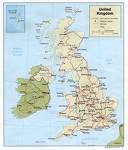 It's no wonder that people in the 'British Isles' have long struggled with defining their own identity and are now turning to a more regionally distinct sense of self.
To take the example of myself, I was born in England of English parents, then schooled and raised in Wales. I later returned to England to study and live. In Wales, I felt English and back in England, I often felt Welsh (at least at first). This was quite confusing in a number of different situations throughout my life. Now, I live in Japan and continue to reshape and redefine my sense of identity.
Last year, the BBC detailed another survey titled 'Brits Abroad', this time by the Institute for Public Policy Research, which found that 'an estimated 5.5m British people (people born in the UK and registered as British citizens) live permanently abroad – almost one in 10 of the UK population.' The IPPR found that 'there are more Brits living abroad than there are foreign born people living in the UK'.
What makes such a large number of people leave the place that they were born in? They (we) are mostly not forced out as refugees of war or through persecution. Perhaps one of the consequences of being born into such a cultural mix-up as Britain leads one to be both less rooted in one particular sense of self and also more inclined to explore other places. Of course, some of the reality as well is to escape from crap trains and crap weather!
 As a teenager, I explored the British Isles with my family and made emotional connections to much of the rest of the country. As a young man in my twenties, being just 'British' was not quite enough, so I decided that I needed my thinking to be broader and pitched my sense of self at becoming more 'European'. Through visits and experiences in France, Germany, Holland, the Czech Republic and Greece (amongst a few others), I hit that aim and in my head I was no longer simply British, but now European. In tune perhaps with these changing times, by my thirties, one continent was no longer enough and I left Europe in search of a more international or global mindset. I moved to Japan, and travelled to China, Korea, Tanzania, Nepal and the UAE.
We have a series of different identities to contend with in our lifetimes.
It is the acknowledgement of these simple facts and the recognition of each of us as being part of the same family that, I think, provides the key to our ongoing survival as a species. The nation state model has been effective in a number of ways yet has also proved to be disastrously divisive and the cause of much of our history's warfaring.
If we are to avoid the threats from state proliferation of weapons and militarism, the twin terrors of deprivation and terrorism, and the global threat of human-caused climate change, then we all need to start thinking more about all other people as brothers and sisters of the same family as ourselves.
Perhaps only then does mankind have a future.
 It's easy to look at Japan in that way. There are four main islands - Honshu, Hokkaido, Kyushu and Shikoku - plus the Okinawan archipelago to the south of the main islands. All of these are defined as 'Japan' and people here define themselves as belonging to that identity, even if they might be more likely these days to holiday in Hawaii than Okinawa and still find others within the nation as substantially distinct from themselves.
Nevertheless, it's still quite an easy thing to define the nation of Japan. When it comes to the UK, that's much more difficult. The United Kingdom consists of four states (?) - England, Scotland, Wales and Northern Ireland. Great Britain/Britain consists of three - England, Scotland and Wales. If we look at the individual components of that union, what are they - countries, states, nations, regions?
 It's no wonder that people in the 'British Isles' have long struggled with defining their own identity and are now turning to a more regionally distinct sense of self.
To take the example of myself, I was born in England of English parents, then schooled and raised in Wales. I later returned to England to study and live. In Wales, I felt English and back in England, I often felt Welsh (at least at first). This was quite confusing in a number of different situations throughout my life. Now, I live in Japan and continue to reshape and redefine my sense of identity.
Last year, the BBC detailed another survey titled 'Brits Abroad', this time by the Institute for Public Policy Research, which found that 'an estimated 5.5m British people (people born in the UK and registered as British citizens) live permanently abroad – almost one in 10 of the UK population.' The IPPR found that 'there are more Brits living abroad than there are foreign born people living in the UK'.
What makes such a large number of people leave the place that they were born in? They (we) are mostly not forced out as refugees of war or through persecution. Perhaps one of the consequences of being born into such a cultural mix-up as Britain leads one to be both less rooted in one particular sense of self and also more inclined to explore other places. Of course, some of the reality as well is to escape from crap trains and crap weather!
 As a teenager, I explored the British Isles with my family and made emotional connections to much of the rest of the country. As a young man in my twenties, being just 'British' was not quite enough, so I decided that I needed my thinking to be broader and pitched my sense of self at becoming more 'European'. Through visits and experiences in France, Germany, Holland, the Czech Republic and Greece (amongst a few others), I hit that aim and in my head I was no longer simply British, but now European. In tune perhaps with these changing times, by my thirties, one continent was no longer enough and I left Europe in search of a more international or global mindset. I moved to Japan, and travelled to China, Korea, Tanzania, Nepal and the UAE.
We have a series of different identities to contend with in our lifetimes.
- The personal identity and our individual sense of self (Who am I? What am I? What do I want to be?).
- The local identity (our place in our own community).
- The national identity (what it means to be a citizen of the country on our passport).
- The global identity.
It is the acknowledgement of these simple facts and the recognition of each of us as being part of the same family that, I think, provides the key to our ongoing survival as a species. The nation state model has been effective in a number of ways yet has also proved to be disastrously divisive and the cause of much of our history's warfaring.
If we are to avoid the threats from state proliferation of weapons and militarism, the twin terrors of deprivation and terrorism, and the global threat of human-caused climate change, then we all need to start thinking more about all other people as brothers and sisters of the same family as ourselves.
Perhaps only then does mankind have a future.


