Thought that 'the battle to save the Internet' was won with the defeat or shelving of SOPA? Think again. To paraphrase Clay Shirky from the last video I posted here, the price of a free Internet has to be eternal vigilance, it seems.
What's next? Here are 10 things about ACTA, an international trade agreement now signed by representatives from 31 states.
The Anti-Counterfeiting Trade Agreement (ACTA) is a plurilateral agreement for the purpose of establishing international standards for intellectual property rights enforcement. The agreement aims to establish an international legal framework for targeting counterfeit goods, generic medicines and copyright infringement on the Internet, and would create a new governing body outside existing forums, such as the World Trade Organization, the World Intellectual Property Organization, or the United Nations.
The agreement was signed on 1 October 2011 by Australia, Canada, Japan, Morocco, New Zealand, Singapore, South Korea and the United States. In January 2012, the European Union and 22 of its member states signed as well, bringing the total number of signatories to 31. After ratification by 6 states, the convention will come into force.
Supporters have described the agreement as a response to 'the increase in global trade of counterfeit goods and pirated copyright protected works'. Large copyright-right based organizations such as the MPAA and Pharmaceutical Research and Manufacturers of America were active in the treaty's development.
Opponents have lambasted it for its potentially adverse effects on fundamental civil and digital rights, including freedom of expression and communication privacy. Others, such as the Electronic Frontier Foundation, have derided the exclusion of civil society groups, developing countries and the general public from the agreement's negotiation process and have described it as policy laundering. The signature of the EU and many of its member states resulted in the resignation in protest of the European Parliament's appointed rapporteur (Kader Arif), as well as widespread protests across Poland.
This wiki page from La Quadrature du Net details lots of actions that can be taken by those who oppose ACTA.
6. Petitions
A big one from Avaaz.org and a smaller one for HM Government (UK). Another one from Access Now. Click on the screenshot below to go to their page detailing Europe-wide protests against the agreement on February 11th.
7. Rights Groups
We're getting to crunch time. The ball is now very much in the European Parliament's court. The good news is, that gives you a chance to say why we think ACTA is such bad news. Finally, a mechanism to influence the course of this international agreement.
European Digital Rights says that ACTA will have 'major implications for freedom of expression, access to culture and privacy', and have launched a 'What's Wrong With ACTA Week'. The page linked to also contain briefing documents aimed at presenting the key areas that this agreement aims to cover. Another good booklet of theirs is 'What Makes ACTA So Controversial (and why MEPs should care)' - also available in many other European languages.
EFF talks about ACTA's 'global consequences' and more here.
OK, so here were my 10 things about ACTA. Some parts of this post are a little sketchy though. What legal decisions have you come across that favoured fewer restrictions on copyright rather than more? Do you know any other good examples of content owners that have benefited from a more open approach to their work, or who have 'gained from sharing'? Add your suggestions in the comments below and I'll update this post with any good ones that come by.
The original plan, when this feature was launched, was for a guest post a month. But then the summer took over, I got distracted by a number of changes and things I've been trying to finish off for aeons, and blogging fell a little by the wayside. Having made such great efforts earlier on this year at keeping this thing running and upping the ante over previous years...well, you know how it goes.
Anyway, despite my own lackadaisical efforts of the last month or two, I'm proud to announce Guest Post No. Two, and what a huge heap of fun it is too! It's also taken me a while to get this posted as I simply had to watch all the treats that have been sent my way for the post. Having done so, I'd suggest you either make a drink and give yourself half an hour for the fun and games below or come back to them in bursts - each video is a joy in their own right and is the largest number of videos included in one post here.
I'll leave Sarah to introduce herself, but I will add to her introduction that there is so much about blogging that I've learned from her. There's a lot more other stuff I've learned from her too as a colleague and co-teacher on the same course, but blogging's what we're on about here.
So a big thanks to Sarah, and enjoy what you find here!
***
Now, first off, thank you Dom, for inviting me over to your swanky new site, and apologies for the massive fail that was this post happening in July! *ahem*
I’m Sarah, I teach IT (that sounds like 'I know Kung Fu' from The Matrix heh heh) and Dom is both friendly neighbour and supportive colleague …. win win for me.
I have a nerdy/stitching blog called Pings and Needles (I don’t think anyone gets the Pings pun, ho hum) so please come and visit me over there. I’m currently working on a quilt for a competition at that temple to cryptography Bletchley Park ! …
I proudly present my personal Top 10 Rube Goldberg clips. The general idea behind a Rube Goldberg (or Pythagoras Switch) is to have maximum complexity or stages to accomplish a simple task.
Some of these are epic, some are just put together in people’s homes … go get yourself a cup/glass/yard of refreshment and settle in for some genuinely brilliant stuff.
1. 2D Photography - Watch and Gasp. The detail, oh the detail.
2. Baynham & Tyers - edited, but I love the way it travels through a whole house!
3. Honda - TV ad - just beautiful
4. Ramen noodles! The Japanese presenter is soooo dramatic!
5. Falling Water Cocktail - watch for the tape measure - genius!
6. 'Exercise in Fugality' - George Rhoads - Kinetic Sculpture - strictly speaking this isn’t a Rube Goldberg, but it sounds good and I like it.
7. Creme Egg Squasher
8. Toy Factory - lovin all the nailbiting concentration
9. Random selection of Japanese runs
10. OK Go - music video - you’ve probably seen this already, but it’s worth every second. Live a little - go full screen!
That’s my 10 … I hope you enjoyed a little time wasting - nothing like the amount of time these chaps put into the machines though. I feel happy with that thought.
It gives me great pleasure to welcome my first guest poster onto this blog! Launched just two weeks ago, the new '10 things...' feature prompted my first comments in a while and a wee flurry of interest by other bloggers up for a go at it. I'm delighted to hand a platform over to Eva Büyüksimkeşyan for this post.
Eva lives in Istanbul and has been teaching English for more than 20 years. She says that she loves her job because it is challenging, it enhances creativity, it enables her to stay young and it helps her to become a life-long learner (can certainly agreed with each of those points regarding teaching!). We met at the Blogging Forum at this year's IATEFL, so she makes a very appropriate contributor for a guest post. Eva blogs here and tweets here.
So without further ado, over to you Eva.
*****
Some people love making lists. They have lists everywhere on their notice boards, in their agendas, on refrigerators, etc. I’m also in favour of lists for many reasons. When I make lists,
I feel I’m more organised.
I will be less stressed.
I know that I won’t put off the things I have to do.
Teaching is a very challenging job and we need to be organised and well-planned to achieve our goals.
I decided to write a 10 things ... list that we can prepare before the new term next year to help us be more organised.
Here is my list:
Before you enter your new class next year, make your first-aid lists. Create a folder for them.
Create a ‘10 things I want to do before the end of this academic year’ and highlight your aims.
Create your initial list of strategies to deal with difficulties and classroom management. Leave space to add more strategies as you experience your new class.
List the things you do to improve yourself. Have a list of people or groups whom you can rely on when you need help. A PLN list on twitter or FB is ideal for this purpose.
List your favourite tools and leave space to add more to your initial list.
List your-must-be-visited-as-frequently-as-possible list of websites.
Organise your files and bookshelves and have an easy way to reach whatever you want when you need.
List favourite games and activities and have it somewhere you see every day so that you can use them frequently.
Decide how you will praise and motivate your students and list a few statements you can use to encourage good work. (not the usual clichés)
Create a list of ‘10 things I should never do and say in my class’.
Make a list of ‘my strengths and my weaknesses’ and find ways to change things for better.
*****
That's a highly useful list of lists, I think. Quite a few things I've never really thought of. If I even managed half of those, I'd be a far better organised teacher! I'm currently going through number 6. at the moment - being the end of two different courses, one long, one short - and it's making quite a difference to how prepared I feel for my next classes.
Over to you now readers. For the teachers among you, how do you prepare for a new term? For non-teachers, does this list translate across to your profession?
In order to provide some sort of structure to a new feature here at 'Postings From An Edge', here are 10 things about '10 things...'. This will give me a framework from which to write and guidance to any future guest posters.
'10 things...' posts...
can be a simple text-only list, a collection of multimedia-rich content, or anything in between these two pillars (including only images, only audio or only video).
can be long or short.
will come from me or from any guest posters that wish to contribute to the feature.
can be posted regularly or sporadically.
must be titled in the same way (beginning with 10 things... and continuing with a grammatically correct rest of sentence) and contain an appropriate collection of meta-tags.
should be promoted elsewhere on the Web (e.g. on Twitter or Facebook).
can be about any topic so long as it relates in some way to the concept of 'thinking globally'. Suggestions for specific topics include technology, education, music, activism, Japan, writing, travel or peace.
can be submitted in a language other than English, so long as an English translation is also provided.
are intended to encourage comment and interaction.
must total 10 things. No 9's or 11's (unless it's a '10 things...about 9/11' post). They must also not be abusive or offensive, and use of Creative Commons works are encouraged.
I'll be starting to approach other bloggers I know with requests for contributions, but if you're reading this and would like to write one, please email it in full (title, content and tags) to dompates.postings@blogger.com - they'll be published (if they meet the above conditions) following editorial review.
It was my first real participation at an international conference, both as delegate and speaker. It meant 'taking my professional game more seriously and to another level'. It was a chance to formalise and build on my emerging Personal Learning Network (PLN). It was making a group of new friends, having a good time with them, and introducing them to my home town. It was picking up new principles and practices I could apply in the classroom, plus sharing new ideas and reaffirming existing ways of doing what I do. It was many different things to many different people, and a sprawling beast of an event it was.
For the unfamiliar, IATEFL is the International Association of Teachers of English as a Foreign Language – a British-based organisation founded in 1967. Brighton 2011 was the 45th annual conference – how lucky to have had my first one occur on my doorstep!
This review started as a blow-by-blow account of each worthy moment I encountered, but it would have taken far too long to get that written up. Instead, I'll use this review to launch a new feature on 'Postings From An Edge, which I'll call '10 Things…'. It'll still end up a sprawling piece of text, but it will act as a good opportunity to pick out the highlights before they end up getting lost to the sifting sands of time.
Without further ado then, here are 10 things about IATEFL 2011.
1) My first time as a delegate at an international conference
Going to and presenting at an international conference are often seen as a sign that things are on the up career-wise. For me, it was an indication that I recognised teaching as being what I do professionally (having spent such a significant part of my career so far teaching whilst trying to be doing something else), and something that I take seriously enough to develop further in it. Furthermore, it was an opportunity to spend time in the company of other people who had already perhaps long since made that same decision.
Teaching is not an easy job. It can drain your energy, be poorly paid or even terrifying (for those that can't face the prospect of standing up in front of others day after day). However, it can also be highly rewarding in a multitude of ways – most importantly in its role of facilitating other peoples' learning. For some folks, the realisation that they make a good teacher (or at least are good at helping other people learn) comes long before they have finished their own schooling. For others, it comes later on, once they have settled into the job and found their feet. There are, of course, those that never wear these shoes comfortably even though they walk in them every day. Although I was not one of those of those that got it early, I'm delighted that the shoes now fit.
I began proceedings with a session from ex-IATEFL president Susan Barduhn on 'How to…get the most out of the conference'. She started by asking the audience where they were from. Answers came back…'Iraq', 'Singapore', 'Palestine', 'China', 'Algeria', 'Egypt'. After a hand holding through the vastness of the conference programme, she mentioned that it was important to consider what our goals were in attending the conference. I could think of many, but the main one was really to get a 'first big conference' under my belt.
With a goal like that, it didn't really matter what happened, so long as something did. And over the two full days and other grabbed moments at the conference, plenty happened.
2) Other delegates and the general vibe
I have organised a conference myself before, been to a stack of others, and spent a lot of time in teacher training events. None really compared to the convivial atmosphere at IATEFL. With a diverse range of people from over 100 countries in attendance, there was a real friendliness in the air, even with strangers that I had no prior technologically-mediated relationship with.
I attended the welcome reception at the Brighton Centre on the evening before the official opening. Grabbing a complimentary glass of wine or two, I ambled around the room in the hope of finding a friendly face. At first, I made out some of the 'big names' in ELT - those whose faces I'd seen online or on the back of books. Nicky Hockly and Gavin Dudeney looked organisational. Ken Wilson held court, looking as in his element as Brian Jones at Monterey Pop. Nik Peachey seemed unassuming, despite the number of people that were clearly gravitating towards him. Peachey’s outlook appears to be that 'the internet's happening anyway, so we might as well learn how to use it and to use it well rather than run away from it', a school of thought I’m certainly a subscriber to.
After a while, I got the weird sensation of familiar features beginning to emerge from the sea of unfamiliar faces as Twitter avatars started coming to life and I began recognising people I'd had fleeting (tweeting?) snatches of conversation with online. Despite having previously met almost no-one face to face, I ended up with plenty more snatches of conversation, just like on Twitter. Happily, this led to ending up in an Italian restaurant with a bunch of new friends, getting through pizza while chatting about lexis, the conference, meta-tagging and the joys of blogging.
The following evening, Macmillan held a party to celebrate the tenth birthday of OneStopEnglish. The party was down at the Honey Club on the seafront, which took me back a little to my student days. The publishers had thrown in a buffet, free wine and even an Elvis impersonator (who looked far too young to have even heard of Elvis, but had a voice befitting of his role). It was a great chance to consolidate some new friendships.
These were just two incidents of the great vibe that was in the air most of the time, which can make or break a conference.
3) Building a PLN
This is a kind of extension of the last point.
Kate Klingensmith describes a PLN as 'the entire collection of people with whom you engage and exchange information, usually online.' Pooky Hesmondhalgh suggests that a PLN offers the chance to do the following:
Talk to like-minded, real people
Share and exchange a range of ideas
Inject creativity into everyday practice
Enjoy a constant flow of ideas
Encourage innovation
Discuss and consider controversial thoughts
Develop enthusiasm and passion
All of these would make a PLN a pretty useful beast. These are the kind of things that, for a teacher, tend to come from time spent in the staffroom. In my current role, I do that very little, generally dividing my work time between darkened IT labs and a strip-lit windowless office nearby. Although I am connected to colleagues through various social networks, the daily shared ideas that help us do our jobs mostly tend to come more in snatched conversations in the cafeteria than online (with one exception).
So, step forward a new PLN. A big thanks you to all of you for the quality time spent in your company at the conference and beyond. My very humblest of apologies to anyone I regretfully left out here (it's only a Twitter list, so I've only got people who are on Twitter in it at the moment). I look forward to many more engagements to come.
Despite having recently gained a postgrad qualification in English teaching and being a delegate at the country's biggest conference for English teachers, I am no longer a teacher of English language. These days I teach IT, but to students whose first language is predominantly not English. The approach of teaching them a subject in a second language rather than teaching them that language is often termed Content and Language Integrated Learning (or CLIL).
Although my main thing at the conference was tech stuff, I was on a CLIL tip too, and the first session I attended ('CLIL Projects for Younger Learners') was on that. Given by Hanna Kryszewska, an editor of 'Humanising Language Teaching', she spoke to a full house and gave some useful pointers for keeping a subject engaging when it's being taught in a language that is not your mother tongue. Some of these were:
Teachers can learn the subject along with the students (most useful if their background is more in language teaching). This is particularly important as teachers need to get the facts right.
Teachers need to give clear explanations, but make sure to make appropriate use of the relevant professional terminology.
Clear grammar structures are still needed despite the focus not being on grammar itself. This can help to reinforce language structures.
Careful consideration should be given to the use of coursebooks, which need to have relevance and context.
Fictional stories and the use of fine arts can be helpful teaching aids.
Stella Kong from Hong Kong also gave some useful tips in a different session on teaching CLIL, this time from a secondary perspective. As with the other speaker, she spoke to a full house and in a much bigger room too - this was clearly a methodology that a lot of people were hungry to learn more about. The examples she gave were from teaching Chemistry and Geography, and were the results of a study that was done with subject teachers who lacked specific language training. Key points here included:
Teachers should plan from the content (rather than from the language). The content provides a context and a purpose for recycling some of the same language that students will be learning elsewhere.
Teachers should teach the language of the content explicitly, which can be done through a range of means including subject specific vocabulary, use of nominalisation and complex noun phrases, and the language of definition. This can better facilitate noticing in the students, an activity which helps them to better acquire features of the language (according to Schmidt's 'noticing hypothesis').
Content and language should be well integrated.The use of complex content should lead to more complex language use.
Listening to these talks was a good reminder that if students can't understand the language, they can't understand the content. They also reinforced the idea that I need to pay further attention to planning key lexical items prior to delivering the lessons.
5) Technology and the ELTJ debate
One of the real highlights of the conference and a clear indicator of the ever-widening divide between those that integrate tech wholeheartedly into their teaching and those that shirk it at every opportunity was the ELTJ/IATEFL Debate 'Tweeting is for the birds, not for language learning'.
Proposing this motion was Alan Waters of the University of Lancaster. Opposing it was Nicky Hockly of The Consultants-E. It was made clear that the debate was not just about Twitter itself but rather the debate around the role of technology in language teaching in general. From the programme:
The role of technology in language teaching has been debated since the first use of the tape recorder and the language laboratory, but never so keenly as today. The universal availability of the internet and social media, the development of interactive whiteboards for the classroom, and the proliferation of online and blended courses means that more technology is available to language teachers and learners than ever before. But does it work? Or are we seduced into using technology because it's fun and it's there?
Waters started, with the assertion that he is broadly supportive of the use of tech in language teaching and that he tends to be an 'early adopter' of much technology himself. However, continuing with a paraphrase of a famous expression – 'All power corrupts, PowerPoint corrupts absolutely' (I'd agree that there are many people who utterly abuse this tool, and not just in teaching) – he went on to list his reasons for the motion. These included the tendency of the use of IWBs in making classes much more teacher-centred (only if the teacher lets it), and the idea that hyperlinked reading leads to a more shallow absorption of content. I have some sympathy for this view as I spend less time on longform reading these days and am more easily distracted than I feel I once was. However, I also feel that individuals should train themselves to get through an online text in whole or choose to surf it as part of developing contemporary media engagement skills.
Hockly followed Waters, beginning by describing herself as a former technophobe turned technophile. I stopped taking notes during her speech as Tweetdeck was displayed behind her allowing those of us in the audience that were tweeting during the debate to interact more closely with it by appearing on the projected stream. This made the debate much more engaging, but also opened up the divide between the digerati and non-digerati in the room, which was made more evident by the questions that came from the crowd at the end.
Not surprisingly though, the motion was ultimately opposed. An incorrect embed code has prevented me from showing it in full here, but you can watch it at this link.
6) The ELT Blogosphere Symposium
The symposia were good choices for spending a full afternoon of exploring a specialist area in depth, in the company of kindred spirits. I went for a symposium on the blogosphere, being something I often use in class and do myself when I’m not teaching.
There were four sets of speakers – Karenne Sylvester, Tara Benwell, Peter Ryley and Jennifer Wain, and Berni Wall. Convenor Karenne kicked off with the statement ‘Blogging changed my life’. She proceeded to give a short history of blogging itself and describe her story, making it clear that it is not easy to get a successful blog up and running, but it can be highly worthwhile if you get there. She also mentioned that blogging works once there is a community around it – something that in five years I have not managed to successfully achieve with this one (although admittedly I’ve not been trying too actively either).
Tara described some of the features of her space at myEnglishClub.com and how having this online space seems to have made a real difference in her learners’ lives (who are mostly blogging from somewhere where they are fairly isolated as learners). She described blogs as useful places to introduce and model online tools such as Wordle and Audioboo, and invited contributions to the blog describing it as a sandbox for teachers to try out their ideas.
Peter and Jennifer, whom I’d already seen present on their topic at the Study Group conference, described a blogging project for lower level language learners that not only gave their students a space for practicing their language but also for engaging with the culture around them. A useful pointer from them was how a blog moves the centre of gravity from the classroom to a wholly different space.
The final speaker was someone who is very busy online, as moderator of #ELTchat on Twitter amongst many other things. She started with an excellent activity that demonstrated how a PLN works, showed how to organise via Tweetdeck and extolled Twitter’s virtues as a portal to plenty of other things online. During the talk, she mentioned that an awful lot of collaboration had emerged from Twitter chats and finished by boldly stating that using technology in teaching is no longer a choice, it’s a must.
The symposium ended with a great Q&A, where people described the impacts that blogging had had for them, the challenges they’d faced in getting ‘non-believers’ on board, and how effective the Twitterverse and blogosphere were in acting as a global staffrom. Overall, it was a great session that spanned inspiring testimonies, exciting discoveries and a host of new friends. Must work harder at building community round my own online spaces rather than keeping up with them as broadcast mechanisms…
An honorable mention here must also go to Burçu Akyol, who gave an inspirational talk on blogging at a different sesion, and reminded us why blogs are like sharks (who must keep moving forward or they die). Kudos to her for having even got Turkish kindergarten students blogging in English.
7) Pecha Kucha
At the risk of namedropping, I have a personal connection to Pecha Kucha that has tended to pique my interest in it. Back in 2006, I launched a charity CD that I had co-produced, at a club called Super-Deluxe in the Roppongi district of Tokyo. That same club was the place where architects Mark Dytham and Astrid Klein launched the first Pecha Kucha night three years earlier.
Pecha Kucha is form of public presentation where each presenter has a total of 20 slides, each of which is shown for 20 seconds. This gives every presenter – whoever they are – 6 minutes and 40 seconds to get their message across or explain their ideas before the next one steps up to the fray.
Done well, it can be both inspiring and hugely entertaining. Done badly, it can look like a bit of a shambles, but only if the presenter themselves is not up to the task. Pecha Kucha Nights are now a global phenomenon and I'd seen one in Brighton before - part fascinating, part rubbish. However, Pecha Kucha at IATEFL has its own quality reputation and it turned out to be rightfully so. Kind of how it should be at a conference full of language teachers, who ought to be better than most at communicating with a large room full of strangers.
It was such a rush that I was barely even able to tweet during the presentations. Instead of taking my word for it though, try the video of the event above and see for yourself. A highly memorable evening and a speaking platform to aspire to.
The speakers, in order of appearance, were:
Jeremy Harmer (host)
Petra Pointer
Ying Zheng
Nick Billborough
Bethany Cagnol
J J Wilson
Valeria Franca
Antonia Clare
Alan Pulverness and Sarah Mount
8) My talk
I first considered speaking at IATEFL whilst doing the DELTA, so my talk had been pending for a long time. When it finally came around, it was scheduled in the last period of sessions before the final plenary that signalled the closing of the conference. Although there was a part of me that was cool with whatever time I ended up being on as I was just glad to have the opportunity to present at such an event, another part of me – knowing that plenty of people would have gone home by then – was rather worried that I’d not get anyone turn up to listen. Furthermore, I was concerned that I’d picked a potentially most unsexy topic to present on.
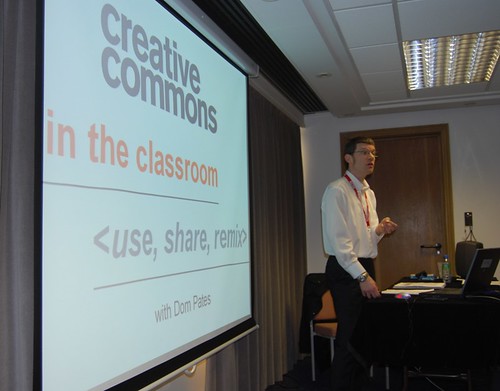
My talk was about using Creative Commons in the classroom, and there are few ways to mention Creative Commons without also mentioning copyright. And generally, unless you’re a creator, a IP lawyer, a manager that needs to get CLA licences or generally geeky about copyright and the internet (as I am), most teachers and learners pay little mind to the topic. In picking this subject, I’d looked through previous Conference Selections publications and conference programmes, and spotted a gap of something that no-one else was talking about. It seemed like an opening, but was also a risk.
I’d had to go back to work on the Monday and Tuesday morning too, so wasn’t able to max out on networking in order to recruit a crowd. I’m not really the type anyway. Despite all this, I ended up with a reasonable audience for the subject and a comfortable enough size for my first time. Having trialled the talk once at the company conference and then twice at a couple of additional in-house workshops in the week before, the slideshow was slick and I was ready to go by the time I was due on.
The talk went well, with hopefully the right balance between audience interaction with each other and having stuff to listen to or watch. I’d been recommended to kick off with a gag, so had one up my sleeve that I dutifully trotted out at the beginning. This lightened things up, although according to one of the participants after the event, I still looked deadly serious. Must try and lighten things up a little if I end up doing one of these things again.
Anyway, I was pleased that my talk managed to kick off some good discussions and sorry that we ran out of time to carry them on any further. I was also grateful that a couple of new faces I’d got to know over the weekend came along to listen or give me a little support. All in all, it was a very satisfying experience and I hope it’ll have been a beginning for international conferencing rather than a one-off. I’m certainly looking forward to whatever the next one is. Still, although I’ll happily talk about Creative Commons to whoever wants to hear about it, I might try and pick a topic that will pique a little more interest next time around!
9) The things I missed out on
With over 500 talks, workshops, debates, symposia, discussions groups and pre-conference events on offer, some great stuff was inevitably going to be missed. Choices have to be made from a sumptuous programme of treats. Some of them could probably be caught later online (if they were captured at the time), but once the momentum has gone, so has the moment.
For the symposia on distance language learning or ELT in Africa, the Interactive Language Fair (sounded intriguing), other talks on CLIL, plagiarism, using a class wiki, or promoting critical thinking, I just had to let them go. You can't win 'em all.
I will squeeze in a shout out to three other speakers here, whose talks I attended – Anne Fox, who raised some interesting questions about managing online reputations; my colleague Mary Henderson, who reported on a fascinating experiment she’d performed with getting her students to create multimedia projects; and Raymond Sangabau from the University of Kinshasa, who spoke on the challenges of teaching EAP to classes of around 350 students at a time.
10) Other people's reflections
(Disclaimer: I make an appearance in the above video)
These were my reflections on IATEFL. Why not take a look at what some of the other delegates had to say?