There is a bill currently being discussed in the US Congress right now that could fundamentally cripple the Internet as we know it, with significant implications for freedom of speech, innovation and internet integrity.
Known as the 'Protect IP Act', this bill is described by Congress as a 'bill to prevent online threats to economic creativity and theft of intellectual property, and for other purposes.' What this would mean in practice is that the US government would have a very powerful tool in its armory for shutting down websites that were accused of allowing user-generated content that infringed copyright law. In other words, the US government would be able to shut down Facebook, Twitter or YouTube if 'pirated content' was discovered hosted by any of these sites. As so much of our lives are now either lived online or affected by unseen transactions that happen in the online world, the passing of this bill could potentially become the point at which the internet revolution is stopped in its tracks.
It also has a counterpart bill being discussed in the House of Representatives, known as SOPA (or 'Stop Online Piracy Act'). Supporters which line up behind the bill include the likes of the Recording Industry Association of America (RIAA), the Motion Picture Association of America (MPAA) and Microsoft. On the other side, organisations against the bill include the likes of Google, Yahoo! and Human Rights Watch.
Watch the video above for the simple message about this bill. Then (if you are American), visit FightForTheFuture.org and register your opposition.
For a more detailed and far longer piece that gives a great insight into the whole thing, visit this article from O'Reilly Radar.
The following images or digital artefacts are ten things that I experienced or took part in in my home town last month.
May is the beginning of festival season in Brighton, a veritable events banquet that runs almost to the end of the year, but particularly throughout the summer. The big beast that kicks things off is the Brighton Festival and its little brother, the Brighton Festival Fringe. As previously mentioned, Aung San Suu Kyi was the (in absentia) guest director which meant that her image was plastered across the city throughout May. The picture above is from a mural on a wall in Vine Street - a really outstanding piece of work.
The Brighton Festival always kicks off with the Children's Parade, organised by local arts organisation Same Sky. I'd never managed to focus on it enough to get a decent photographic record in the past, but this year managed to plant myself on the seafront, DSLR in hand and got some pretty nice shots. The parade goes through the town and involves children (and their parents) from schools across the city and surrounding areas. A really fun way to kick things off.
I went to a talk organised by IDS (where I was once singer in the house band) on 'Can the Media Save the World?', held at the Friends Meeting House. The speakers were good and the audience were eager and attentive, almost disappointed that there wasn't more time to widen the debate.
Some of the points raised included:
media is often a reflection of what's out there rather than an enabler of change
it can be very effective in bearing witness or for exposing wrongdoing
media has often played a vital role in creating public awareness of global poverty
TV should try and engage audiences on important issues through other genres, rather than just news or documentaries
international or development-related content tends to be on niche channels - media providers therefore neglect the wider population
the blogosphere can magnify the impact of an issue
CSR (corporate social responsibility) exists and is widely practiced, why not MSR (media social responsibility)?
Probably the most impressive live event I've been to in at least ten years, DJ Shadow unveiled his 'Shadowsphere' show as part of The Great Escape, at Brighton Dome. Almost the entire show was performed from inside a giant sphere in the middle of the stage, onto which various films and images were projected that seemed to interact with the other projections behind it. One minute a basketball jumping through a hoop, the next the Death Star vanquishing all in its path, and all with a bass so deep that it felt like my internal organs were being regularly rearranged. If you ever get the chance to see this show, go, go go.
Although they are not officially part of the programme, there are often many other great things going on at the same time as the main festival that kind of piggyback onto the bigger one. The above mentioned Great Escape is one of them, and the more genteel St. Anne's Well Gardens festival is another. A real family day out, with lots of face painting, balloons and all that sort of thing, we picnicked in the park in the glorious weather and listened to a brass band as kids ran around us.
For the second year running, I went to see the Brighton Beach Boys. Last year was the show they've been playing for a long time - full live renditions of 'Pet Sounds 'and 'Sgt Pepper'. This year, the first half of the show was a bit tougher to sit through as it was all originals written by one of the core members of the band (and the audience had all come along for Beatles or Beach Boys songs), but the second half was fantastic - a note perfect and highly spirited performance of 'Abbey Road', in its entirety. Great stuff.
A little further out of town (Stanmer Park) and another one of those peripheral events was the Brighton Kite Festival. The weather wasn't so good and most of my pictures came out a little too dark, but there were some pretty cool kites on display, plus it was good to get out of the city for a few hours. I'm due to start studying at the neighbouring university from September, so it also presented a good excuse to have a sniff around the campus again too.
A clash with the Brighton Beach Boys show meant missing the remarkable looking spectacle that was 'Drôles d'Oiseaux', held at The Level. Still, we got off the bus on the way back from the kite festival and took a look at what remained the next day. Yes, they were real cars and no, I have no idea how they stayed up. Damned cool looking though.
I spent a meditative hour or two in the hulk of the Old Municipal Market, the place that was a main fruit and veg wholesaler when I was a student but now lies dormant and empty. Inside, was an installation by Turkish artist Kutluğ Ataman, called 'Mesopotamian Dramaturgies'. This consisted of a series of screens displayed at varying angles, showing close-ups of the flow from waterfalls (including Iguazu), signifying the revolutionary changes happening with the Arab spring and in the region. Although the installations themselves were pretty captivating, the space itself was also rather inspiring and I experimented a little with taking low lit black and white images in an abandoned building. Ended up pretty happy with some of the results too.
Prior to the two hours in an abandoned fruit warehouse, I dropped in to the Fabrica gallery for a sound installation by Janet Cardiff, titled 'Forty Part Motet'. There were forty speakers arranged in a circle, from which individual voices from a choir were played. The recording was on a permanent loop and the installation itself gave the effect of standing in the middle of a choir, hearing the voices as the choir hears them rather than from where the audience does. Click on the field recording below to hear a little of what it sounded like (but not get a feeling of what it was like to be surrounded - can only really do stereo here).
Of course, there was so much more to see and do. Some of it I've already mentioned here (such as the Heroes Run and Jardin Flambeau), some of it I had to miss out on for some reason or another. You can find more photos from these events and more at my Brighton Festival 2011 Flickr set.
These ten were some of my highlights. Brightonians and other visitors, what were yours?
It was my first real participation at an international conference, both as delegate and speaker. It meant 'taking my professional game more seriously and to another level'. It was a chance to formalise and build on my emerging Personal Learning Network (PLN). It was making a group of new friends, having a good time with them, and introducing them to my home town. It was picking up new principles and practices I could apply in the classroom, plus sharing new ideas and reaffirming existing ways of doing what I do. It was many different things to many different people, and a sprawling beast of an event it was.
For the unfamiliar, IATEFL is the International Association of Teachers of English as a Foreign Language – a British-based organisation founded in 1967. Brighton 2011 was the 45th annual conference – how lucky to have had my first one occur on my doorstep!
This review started as a blow-by-blow account of each worthy moment I encountered, but it would have taken far too long to get that written up. Instead, I'll use this review to launch a new feature on 'Postings From An Edge, which I'll call '10 Things…'. It'll still end up a sprawling piece of text, but it will act as a good opportunity to pick out the highlights before they end up getting lost to the sifting sands of time.
Without further ado then, here are 10 things about IATEFL 2011.
1) My first time as a delegate at an international conference
Going to and presenting at an international conference are often seen as a sign that things are on the up career-wise. For me, it was an indication that I recognised teaching as being what I do professionally (having spent such a significant part of my career so far teaching whilst trying to be doing something else), and something that I take seriously enough to develop further in it. Furthermore, it was an opportunity to spend time in the company of other people who had already perhaps long since made that same decision.
Teaching is not an easy job. It can drain your energy, be poorly paid or even terrifying (for those that can't face the prospect of standing up in front of others day after day). However, it can also be highly rewarding in a multitude of ways – most importantly in its role of facilitating other peoples' learning. For some folks, the realisation that they make a good teacher (or at least are good at helping other people learn) comes long before they have finished their own schooling. For others, it comes later on, once they have settled into the job and found their feet. There are, of course, those that never wear these shoes comfortably even though they walk in them every day. Although I was not one of those of those that got it early, I'm delighted that the shoes now fit.
I began proceedings with a session from ex-IATEFL president Susan Barduhn on 'How to…get the most out of the conference'. She started by asking the audience where they were from. Answers came back…'Iraq', 'Singapore', 'Palestine', 'China', 'Algeria', 'Egypt'. After a hand holding through the vastness of the conference programme, she mentioned that it was important to consider what our goals were in attending the conference. I could think of many, but the main one was really to get a 'first big conference' under my belt.
With a goal like that, it didn't really matter what happened, so long as something did. And over the two full days and other grabbed moments at the conference, plenty happened.
2) Other delegates and the general vibe
I have organised a conference myself before, been to a stack of others, and spent a lot of time in teacher training events. None really compared to the convivial atmosphere at IATEFL. With a diverse range of people from over 100 countries in attendance, there was a real friendliness in the air, even with strangers that I had no prior technologically-mediated relationship with.
I attended the welcome reception at the Brighton Centre on the evening before the official opening. Grabbing a complimentary glass of wine or two, I ambled around the room in the hope of finding a friendly face. At first, I made out some of the 'big names' in ELT - those whose faces I'd seen online or on the back of books. Nicky Hockly and Gavin Dudeney looked organisational. Ken Wilson held court, looking as in his element as Brian Jones at Monterey Pop. Nik Peachey seemed unassuming, despite the number of people that were clearly gravitating towards him. Peachey’s outlook appears to be that 'the internet's happening anyway, so we might as well learn how to use it and to use it well rather than run away from it', a school of thought I’m certainly a subscriber to.
After a while, I got the weird sensation of familiar features beginning to emerge from the sea of unfamiliar faces as Twitter avatars started coming to life and I began recognising people I'd had fleeting (tweeting?) snatches of conversation with online. Despite having previously met almost no-one face to face, I ended up with plenty more snatches of conversation, just like on Twitter. Happily, this led to ending up in an Italian restaurant with a bunch of new friends, getting through pizza while chatting about lexis, the conference, meta-tagging and the joys of blogging.
The following evening, Macmillan held a party to celebrate the tenth birthday of OneStopEnglish. The party was down at the Honey Club on the seafront, which took me back a little to my student days. The publishers had thrown in a buffet, free wine and even an Elvis impersonator (who looked far too young to have even heard of Elvis, but had a voice befitting of his role). It was a great chance to consolidate some new friendships.
These were just two incidents of the great vibe that was in the air most of the time, which can make or break a conference.
3) Building a PLN
This is a kind of extension of the last point.
Kate Klingensmith describes a PLN as 'the entire collection of people with whom you engage and exchange information, usually online.' Pooky Hesmondhalgh suggests that a PLN offers the chance to do the following:
Talk to like-minded, real people
Share and exchange a range of ideas
Inject creativity into everyday practice
Enjoy a constant flow of ideas
Encourage innovation
Discuss and consider controversial thoughts
Develop enthusiasm and passion
All of these would make a PLN a pretty useful beast. These are the kind of things that, for a teacher, tend to come from time spent in the staffroom. In my current role, I do that very little, generally dividing my work time between darkened IT labs and a strip-lit windowless office nearby. Although I am connected to colleagues through various social networks, the daily shared ideas that help us do our jobs mostly tend to come more in snatched conversations in the cafeteria than online (with one exception).
So, step forward a new PLN. A big thanks you to all of you for the quality time spent in your company at the conference and beyond. My very humblest of apologies to anyone I regretfully left out here (it's only a Twitter list, so I've only got people who are on Twitter in it at the moment). I look forward to many more engagements to come.
Despite having recently gained a postgrad qualification in English teaching and being a delegate at the country's biggest conference for English teachers, I am no longer a teacher of English language. These days I teach IT, but to students whose first language is predominantly not English. The approach of teaching them a subject in a second language rather than teaching them that language is often termed Content and Language Integrated Learning (or CLIL).
Although my main thing at the conference was tech stuff, I was on a CLIL tip too, and the first session I attended ('CLIL Projects for Younger Learners') was on that. Given by Hanna Kryszewska, an editor of 'Humanising Language Teaching', she spoke to a full house and gave some useful pointers for keeping a subject engaging when it's being taught in a language that is not your mother tongue. Some of these were:
Teachers can learn the subject along with the students (most useful if their background is more in language teaching). This is particularly important as teachers need to get the facts right.
Teachers need to give clear explanations, but make sure to make appropriate use of the relevant professional terminology.
Clear grammar structures are still needed despite the focus not being on grammar itself. This can help to reinforce language structures.
Careful consideration should be given to the use of coursebooks, which need to have relevance and context.
Fictional stories and the use of fine arts can be helpful teaching aids.
Stella Kong from Hong Kong also gave some useful tips in a different session on teaching CLIL, this time from a secondary perspective. As with the other speaker, she spoke to a full house and in a much bigger room too - this was clearly a methodology that a lot of people were hungry to learn more about. The examples she gave were from teaching Chemistry and Geography, and were the results of a study that was done with subject teachers who lacked specific language training. Key points here included:
Teachers should plan from the content (rather than from the language). The content provides a context and a purpose for recycling some of the same language that students will be learning elsewhere.
Teachers should teach the language of the content explicitly, which can be done through a range of means including subject specific vocabulary, use of nominalisation and complex noun phrases, and the language of definition. This can better facilitate noticing in the students, an activity which helps them to better acquire features of the language (according to Schmidt's 'noticing hypothesis').
Content and language should be well integrated.The use of complex content should lead to more complex language use.
Listening to these talks was a good reminder that if students can't understand the language, they can't understand the content. They also reinforced the idea that I need to pay further attention to planning key lexical items prior to delivering the lessons.
5) Technology and the ELTJ debate
One of the real highlights of the conference and a clear indicator of the ever-widening divide between those that integrate tech wholeheartedly into their teaching and those that shirk it at every opportunity was the ELTJ/IATEFL Debate 'Tweeting is for the birds, not for language learning'.
Proposing this motion was Alan Waters of the University of Lancaster. Opposing it was Nicky Hockly of The Consultants-E. It was made clear that the debate was not just about Twitter itself but rather the debate around the role of technology in language teaching in general. From the programme:
The role of technology in language teaching has been debated since the first use of the tape recorder and the language laboratory, but never so keenly as today. The universal availability of the internet and social media, the development of interactive whiteboards for the classroom, and the proliferation of online and blended courses means that more technology is available to language teachers and learners than ever before. But does it work? Or are we seduced into using technology because it's fun and it's there?
Waters started, with the assertion that he is broadly supportive of the use of tech in language teaching and that he tends to be an 'early adopter' of much technology himself. However, continuing with a paraphrase of a famous expression – 'All power corrupts, PowerPoint corrupts absolutely' (I'd agree that there are many people who utterly abuse this tool, and not just in teaching) – he went on to list his reasons for the motion. These included the tendency of the use of IWBs in making classes much more teacher-centred (only if the teacher lets it), and the idea that hyperlinked reading leads to a more shallow absorption of content. I have some sympathy for this view as I spend less time on longform reading these days and am more easily distracted than I feel I once was. However, I also feel that individuals should train themselves to get through an online text in whole or choose to surf it as part of developing contemporary media engagement skills.
Hockly followed Waters, beginning by describing herself as a former technophobe turned technophile. I stopped taking notes during her speech as Tweetdeck was displayed behind her allowing those of us in the audience that were tweeting during the debate to interact more closely with it by appearing on the projected stream. This made the debate much more engaging, but also opened up the divide between the digerati and non-digerati in the room, which was made more evident by the questions that came from the crowd at the end.
Not surprisingly though, the motion was ultimately opposed. An incorrect embed code has prevented me from showing it in full here, but you can watch it at this link.
6) The ELT Blogosphere Symposium
The symposia were good choices for spending a full afternoon of exploring a specialist area in depth, in the company of kindred spirits. I went for a symposium on the blogosphere, being something I often use in class and do myself when I’m not teaching.
There were four sets of speakers – Karenne Sylvester, Tara Benwell, Peter Ryley and Jennifer Wain, and Berni Wall. Convenor Karenne kicked off with the statement ‘Blogging changed my life’. She proceeded to give a short history of blogging itself and describe her story, making it clear that it is not easy to get a successful blog up and running, but it can be highly worthwhile if you get there. She also mentioned that blogging works once there is a community around it – something that in five years I have not managed to successfully achieve with this one (although admittedly I’ve not been trying too actively either).
Tara described some of the features of her space at myEnglishClub.com and how having this online space seems to have made a real difference in her learners’ lives (who are mostly blogging from somewhere where they are fairly isolated as learners). She described blogs as useful places to introduce and model online tools such as Wordle and Audioboo, and invited contributions to the blog describing it as a sandbox for teachers to try out their ideas.
Peter and Jennifer, whom I’d already seen present on their topic at the Study Group conference, described a blogging project for lower level language learners that not only gave their students a space for practicing their language but also for engaging with the culture around them. A useful pointer from them was how a blog moves the centre of gravity from the classroom to a wholly different space.
The final speaker was someone who is very busy online, as moderator of #ELTchat on Twitter amongst many other things. She started with an excellent activity that demonstrated how a PLN works, showed how to organise via Tweetdeck and extolled Twitter’s virtues as a portal to plenty of other things online. During the talk, she mentioned that an awful lot of collaboration had emerged from Twitter chats and finished by boldly stating that using technology in teaching is no longer a choice, it’s a must.
The symposium ended with a great Q&A, where people described the impacts that blogging had had for them, the challenges they’d faced in getting ‘non-believers’ on board, and how effective the Twitterverse and blogosphere were in acting as a global staffrom. Overall, it was a great session that spanned inspiring testimonies, exciting discoveries and a host of new friends. Must work harder at building community round my own online spaces rather than keeping up with them as broadcast mechanisms…
An honorable mention here must also go to Burçu Akyol, who gave an inspirational talk on blogging at a different sesion, and reminded us why blogs are like sharks (who must keep moving forward or they die). Kudos to her for having even got Turkish kindergarten students blogging in English.
7) Pecha Kucha
At the risk of namedropping, I have a personal connection to Pecha Kucha that has tended to pique my interest in it. Back in 2006, I launched a charity CD that I had co-produced, at a club called Super-Deluxe in the Roppongi district of Tokyo. That same club was the place where architects Mark Dytham and Astrid Klein launched the first Pecha Kucha night three years earlier.
Pecha Kucha is form of public presentation where each presenter has a total of 20 slides, each of which is shown for 20 seconds. This gives every presenter – whoever they are – 6 minutes and 40 seconds to get their message across or explain their ideas before the next one steps up to the fray.
Done well, it can be both inspiring and hugely entertaining. Done badly, it can look like a bit of a shambles, but only if the presenter themselves is not up to the task. Pecha Kucha Nights are now a global phenomenon and I'd seen one in Brighton before - part fascinating, part rubbish. However, Pecha Kucha at IATEFL has its own quality reputation and it turned out to be rightfully so. Kind of how it should be at a conference full of language teachers, who ought to be better than most at communicating with a large room full of strangers.
It was such a rush that I was barely even able to tweet during the presentations. Instead of taking my word for it though, try the video of the event above and see for yourself. A highly memorable evening and a speaking platform to aspire to.
The speakers, in order of appearance, were:
Jeremy Harmer (host)
Petra Pointer
Ying Zheng
Nick Billborough
Bethany Cagnol
J J Wilson
Valeria Franca
Antonia Clare
Alan Pulverness and Sarah Mount
8) My talk
I first considered speaking at IATEFL whilst doing the DELTA, so my talk had been pending for a long time. When it finally came around, it was scheduled in the last period of sessions before the final plenary that signalled the closing of the conference. Although there was a part of me that was cool with whatever time I ended up being on as I was just glad to have the opportunity to present at such an event, another part of me – knowing that plenty of people would have gone home by then – was rather worried that I’d not get anyone turn up to listen. Furthermore, I was concerned that I’d picked a potentially most unsexy topic to present on.
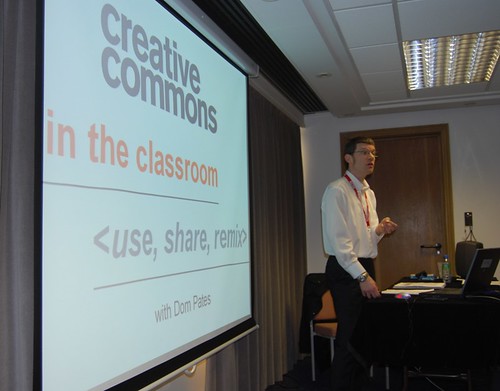
My talk was about using Creative Commons in the classroom, and there are few ways to mention Creative Commons without also mentioning copyright. And generally, unless you’re a creator, a IP lawyer, a manager that needs to get CLA licences or generally geeky about copyright and the internet (as I am), most teachers and learners pay little mind to the topic. In picking this subject, I’d looked through previous Conference Selections publications and conference programmes, and spotted a gap of something that no-one else was talking about. It seemed like an opening, but was also a risk.
I’d had to go back to work on the Monday and Tuesday morning too, so wasn’t able to max out on networking in order to recruit a crowd. I’m not really the type anyway. Despite all this, I ended up with a reasonable audience for the subject and a comfortable enough size for my first time. Having trialled the talk once at the company conference and then twice at a couple of additional in-house workshops in the week before, the slideshow was slick and I was ready to go by the time I was due on.
The talk went well, with hopefully the right balance between audience interaction with each other and having stuff to listen to or watch. I’d been recommended to kick off with a gag, so had one up my sleeve that I dutifully trotted out at the beginning. This lightened things up, although according to one of the participants after the event, I still looked deadly serious. Must try and lighten things up a little if I end up doing one of these things again.
Anyway, I was pleased that my talk managed to kick off some good discussions and sorry that we ran out of time to carry them on any further. I was also grateful that a couple of new faces I’d got to know over the weekend came along to listen or give me a little support. All in all, it was a very satisfying experience and I hope it’ll have been a beginning for international conferencing rather than a one-off. I’m certainly looking forward to whatever the next one is. Still, although I’ll happily talk about Creative Commons to whoever wants to hear about it, I might try and pick a topic that will pique a little more interest next time around!
9) The things I missed out on
With over 500 talks, workshops, debates, symposia, discussions groups and pre-conference events on offer, some great stuff was inevitably going to be missed. Choices have to be made from a sumptuous programme of treats. Some of them could probably be caught later online (if they were captured at the time), but once the momentum has gone, so has the moment.
For the symposia on distance language learning or ELT in Africa, the Interactive Language Fair (sounded intriguing), other talks on CLIL, plagiarism, using a class wiki, or promoting critical thinking, I just had to let them go. You can't win 'em all.
I will squeeze in a shout out to three other speakers here, whose talks I attended – Anne Fox, who raised some interesting questions about managing online reputations; my colleague Mary Henderson, who reported on a fascinating experiment she’d performed with getting her students to create multimedia projects; and Raymond Sangabau from the University of Kinshasa, who spoke on the challenges of teaching EAP to classes of around 350 students at a time.
10) Other people's reflections
(Disclaimer: I make an appearance in the above video)
These were my reflections on IATEFL. Why not take a look at what some of the other delegates had to say?
We awoke on Friday morning and switched on the PCs, as we do every morning, and the news of the quake started coming in - shortly after it had first hit. It continued throughout the day, with my wife fairly desperately trying to get hold of her family who live in Yokohama. Once confirmed that they were alive, we got caught up in the rolling news cycle, which has been flowing ever since then.
It's absolutely horrific to see the devastation that has been wrought on parts of the country, reminding her of the images of Kobe in 1995. I've felt fairly speechless about the whole thing and have just been trying to provide whatever comfort I can. Having spent almost five years of my life in the country and with a large number of my friends still there too, I'm also affected by what I've seen, but couldn't begin to measure up to what she must be going through. I experienced quakes when living there, but nothing like this. Then again, neither has anyone else alive in Japan either, by the sounds of it.
Google have set up a useful crisis page, with a button for donations to the Japanese Red Cross - I've been directly people to that page and asking others to make donations to help with immediate relief and recovery efforts. I would encourage readers of this blog to click on the links and make a donation of whatever size. Japan may be a very technologically advanced nation in many ways, but this is the worse quake it their history and they deserve all the support of the international community that they can get right now.
An American friend of mine who lives in Tokyo and works for an international theatre company emailed the following report to his friends and family, and gave me permission to republish it here. Some of the news might now be out of date, but it gives a flavour of the day it hit for those 200km away in Tokyo and how things are playing out now:
First, all of the members of Tokyo Novyi Repertory Theater are doing good considering the circumstances. For those of you who know Nitta-san, the producer of the theater in Yuda in Iwate prefecture, he was able to get through to us tonight, and told us that the cell phones are working; however there is no power or water in Iwate prefecture. Otherwise, he and his wife are alive and well.
Here is the update from Tokyo. I have typed this up over ~3 hours on Saturday night Tokyo time in between a couple of trips to the store and watching the news. And the news is coming in fast and furious and is not pleasant...
There is quite a lot of apprehension right now about the huge explosion at the nuclear power plant in Fukushima prefecture north of Tokyo. It just came across on the news that the explosion was the outer containment section of the reactor, that it was a hydrogen-based explosion and that the core is not in danger of exploding. The spokesperson also said that they are now pumping seawater into the reactor to cool it down. Everyone here certainly hopes the core is able to be cooled. Facing a worst case scenario is not something we would like to do. Iodine is now being passed out to citizens within the 20km evacuation area surrounding the plant. Fukushima is ~150 miles north of Tokyo.
In addition to the reactor problem, and to a lesser degree, there is a large fire in a refinery in Chiba that is rumored to be sending large amounts of pollution into the air in and around Tokyo. We have been advised to limit our time outside, to cover up our body, and to use umbrellas if it rains to prevent further exposure to contaminants.
Rolling black-outs throughout Tokyo could begin tonight as extra power will be sent north to Sendai and Iwate to assist with the rescue efforts.
The stores have been cleared out of most food and all water as people here are hunkering down. Yoko and I have a solid supply of both plus other needed life supplies.
We have been getting regular earthquakes. I really don't know if they can be called aftershocks as they are fairly large on their own. Many have been level 5-6.5. In fact, we just got another 6.0 as I typed that last sentence that was centered off the coast of Japan near Fukushima. We just spent a few minutes bouncing around lightly.
Yoko has some kind of alarm on her phone that notifies her when there is an earthquake about to hit, and it went off several times last night while we slept. The alarm sounds somewhat like the alarm on a submarine when one of those vessels is submerging, so it definitely woke us up. ;-)
A few friends in Tokyo proper have reported no water, so they are getting drinking water delivered by their local authorities on a daily basis.
Several thousand people are missing in the prefectures of Miyagi and Iwate, and it does not look promising...
The experience of being in an earthquake this big was certainly mind blowing. I was working on the computer at the elementary school where I work part-time, and heard the 'quake before I felt it. I was sitting next to a window, so I moved away to stand next to my desk. It started very gently, and we thought it would be just an ordinary Tokyo light tremble. In fact, one of the teachers, Nishiyama-sensei, saw the concern on a co-worker's face, smiled, winked and said "Daijobu. Dai-ai-ai-ai-jobu (basically, "No problem. No pro-o-o-o-o-oblem."). The intensity suddenly ramped up, a loud "BOOM! BOOM!" started, the building began rolling around, Nishiyama-sensei's expression changed drastically and we all dove under our desks. The school rattle and rolled, and withstood the earthquake very well. Only a few ceiling tiles came down. We have earthquake drills every two weeks or so, so everyone was prepared, and the teachers, staff and students calmly moved out onto the field once the earthquake ceased. The kids were really amazing. The students from one of the 5th grade classes walked out in file through the teachers' room, smiled and said hello in English as they passed and even offered a few high fives. While we were on the field a large aftershock hit and kinda freaked us all out. Then a regular announcement started that continued for the next two hours. A long wailing siren blared followed by this deep, creepy, computerized voice that boomed out over loudspeakers all over the area in both Japanese and English, "This is a tsunami warning. Please move to higher ground immediately." I felt like I was in a Godzilla movie. Beware the monster...The area where the school is located (Takanawadai in Minato-ku) is on top of a tall hill, so we were in one of the safest areas of Tokyo in case of a tsunami.
Over the next hour, parents and grandparents came to pick up the kids, and then it was just the teachers and staff who were left. While we were sitting in the teachers' room, after the students were gone, we watched the news and saw the tsunamis hit Northern Japan. At the same time a really large aftershock hit, which might have been the level 7.1 earthquake listed on the USGS site. After that things, calmed down significantly. The authorities recommended that all of us stay, but I really wanted to get home to Yoko. So, after sitting around for another 90 minutes of fairly quiet time, my American co-worker and I decided to walk down to the nearest train station to find out the status of the situation as the internet and TV reports were vague about train stoppages. When we got to Shinagawa station, we saw a mass of people in various states of standing around. There were approximately 200-300 people lined up to use the pay phones, another couple hundred lined up at the taxi stands and a huge mass of people sitting and standing quietly in the vast station. We tried to get information from station staff and other people to no avail, and then around 6PM an announcement was made that all trains were offline for the remainder of the day and possibly the next. After a short discussion, we decided to make our way on foot to our respective areas.
The walk home was kinda fun. We walked from near Shinagawa station in southern Tokyo to Nakano-Sakaue mostly via Yamate Dori (avenue). During the first hour there were so many people that I was literally shuffling pressed against the person in front of me while making our way to the next station in Osaki. In Osaki, we stopped to use the toilet at a convenience store, and pick up some snacks and water. The line for the toilet was about 30 minutes long and the shelves were mostly bare of food (we were able to get a few bags of chips). We saw a group of salarymen, who were probably either staying at the office or in a hotel, buying a boatload of booze. They had a rack of beer, two bottles of whiskey, snacks and soda, and appeared to be having a great time. Once we were done with our pit stop we continued on our way with thousands of other people. I want to emphasize that I am not exaggerating the number of people. Thousands. The sidewalks were full and in some places the people would just take over lanes of the roadway. Automobile traffic was barely moving, and, we had no desire to catch the buses crammed with people stuck in traffic that we were passing on foot. The people we encountered were generally light-hearted and orderly. Everybody just wanted to get home. We passed a few local bicycle shops, and they were each doing brisk business with upwards of twenty or so customers in each shop. Several restaurants, condominiums and apartment buildings set up rest areas for people with water, warm drinks and access to toilets. My admiration for the Japanese people increased massively with this experience. The behavior of people was pure grace under pressure. I saw only one...one...person causing a problem the whole of my journey.
My cell phone battery had died prior to my departure from the school. This was not a problem for phone calls as those were not going through, but it was a problem for email 'cause that was working. We passed many pay phones with lines of 40-50 people before we found a phone with one lone person using it in Naka Meguro. I was able to reach Yoko on our land line, we updated each other after no contact for 4 hours or so, and then it was off to complete our journey. We finally arrived in Nakano-Sakaue around 10:30PM. My co-worker was exhausted and had decided to find out if there was room in a hotel. Luckily, we bumped into another teacher we both knew, and he told us that one of the subway lines had just started running. This allowed the co-worker I had journeyed with to take a train to within one station of her home. I was a mere 5 minutes from my home in Nakano-Sakaue. Waiting for me was a smiling wife and a hot meal.
Kicking off this year is a gallery of a few moments stolen from last year. Contained in the above slideshow are a selection of Brighton pictures that never made it online last year, including of the Children's Parade that kicks off the festival, the Brighton Beach Boys from their concert at St. George's Church in Kemptown, snaps from Hove Champagne Festival and a few obligatory ones of the beach.
Over on my Flickr site, there's a few new pics of Tokyo too, coming before a stack more that should be due soon.
Dear readers, the stats tell me there's quite a lot of you out there, and from all over the place too. Do drop by and say hello from time to time - I'd love to hear from you!